Monday, November 30, 2015

Etiology/ Pathophysiology of Ascites

The accumulation of ascitic fluid is due to an excess of sodium and water in the body.  But there are a few different theories that propose the actual cause of ascites because that is still somewhat unclear.  The theories are the under-filling, overflow, and peripheral arterial vasodilation theories.

http://medical-dictionary.thefreedictionary.com/Peritoneal+cavity+fluid
1) Under-filling Theory: the kidneys' sodium and water retention is due to ineffective blood volume circulation and portal hypertension which causes the splanchnic vascular bed to fill up with fluid in the wrong manner.

2) Overflow Theory: proposes that the main problem in ascites is that the kidney does not retain sodium and water as well as it should even when the volume is not abnormally low.

3) Peripheral Arterial Vasodilation Theory: includes parts of both of the above theories.  Suggests that portal hypertension causes vasodilation and a less effective arterial blood volume but also that more sodium in the kidney is retained and the volume of plasma expands as the disease that is causing the ascites continues.  The excess of fluid from the renal retention of sodium ends up overflowing into the peritoneum.  Says that usually in the earlier stages under-filling is common and overflow is common later in the progression of the disease which is usually cirrhosis.


https://www.netterimages.com/pathophysiology-of-ascites-formation-labeled-runge-im-2e-internal-medicine-frank-h-netter-19946.html


References:
http://emedicine.medscape.com/article/170907-overview#a5


Sunday, November 29, 2015

What's the big deal? ~Epidemiology~

Epidemiology deals with the incidence, distribution, and control of a disease in a population.  Since ascites is a result of certain diseases and not necessarily a disease, there is not much information about the epidemiology of it.  Ascites has a prevalence of 10% when it comes to cirrhosis of the liver.  It is the most common complication of it.  Unfortunately, ascites has only a 56% chance of survival three years after its onset.  It has also been shown that patients with a case of cirrhotic ascites have a three year mortality rate of 50%.  Ascites can be minimized by different means such as draining the fluid of the peritoneum, but sometimes the fluid quickly returns or doesn't go away, which is called refractory ascites.  Refractory ascites has only a one year survival rate of less than 50%.  Ascites increases the morbidity of cirrhosis because it can bring along other complications.  These complications include hepatorenal syndrome- a type of kidney failure, and spontaneous bacterial peritonitis which is an infection of the ascitic fluid which has a reported incidence between 7 and 30% of people with ascites.  It has been stressed that when ascites becomes apparent, it is important to understand the pathophysiology in order to adequately treat it and prevent further complications.  

In healthy people, it has appeared that men have little to no fluid in their peritoneum, but women may have as much as 20mL, depending on their menstrual cycle.


References:
http://www.merriam-webster.com/dictionary/epidemiology
http://emedicine.medscape.com/article/170907-overview#a6
http://www.ncbi.nlm.nih.gov/pubmed/22541699
http://www.ncbi.nlm.nih.gov/pmc/articles/PMC2886420/
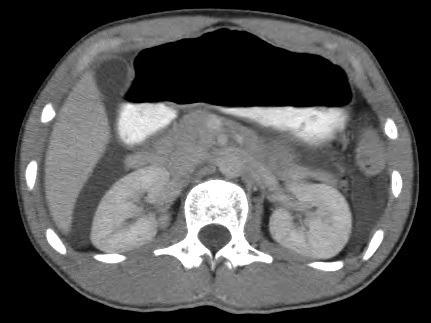
Picture from:
http://emedicine.medscape.com/article/170907-overview

What in the world is ascites?

Ascites is the swelling of the abdominal cavity due to the buildup of protein-containing (ascitic) fluid in the peritoneum.  Ascites often results from cirrhosis of the liver, but can also be due to pancreatitis, heart or kidney failure, and different cancers in the abdomen.  


  https://flowvella.com/s/1y65/1E1130A4-6820-4C2F-9C70-A36D012AC117

 The ascitic fluid often accumulates due to the kidneys retaining fluid, changes in hormones and chemicals that regulate the fluids in the body, and portal hypertension.
http://www.4to40.com/ayurveda/index.asp?p=Ascites_(Ayurvedic_Name-_Jalodar)


References:

  • http://www.merckmanuals.com/home/liver-and-gallbladder-disorders/manifestations-of-liver-disease/ascites
  • https://www.nlm.nih.gov/medlineplus/ency/article/000286.htm